
Delivery apps are built to limit human exchange in service of speed and efficiency – but you still have to meet at the door. Work Party is a series of experimental, high-speed gatherings between gig workers and app users in Bangalore where I use the delivery apps’ own mechanics to produce a party. The food, party decor and guests all arrive through ordering on the platform (a Blinkit worker delivers a folding chair for the next worker to sit in, a Swiggy worker brings tea, we all share it).

The first series of parties included 47 delivery workers over a span of two weeks, beginning with one-on-one meetings and culminating in a day-long party. The most workers in my home at once was 12. We drank tea, sang karaoke, tried foot massagers, discussed politics. These gatherings asked the question: can meaningful exchange happen at high speed?
The following text documents the “parties”. Everything is an approximation from memory and my notes – workers’ names and identifying details have been changed while keeping a similar character and origin. Every delivery received five stars. A note inserted in the app instructions along with a sign in the elevator attempted to assure the workers in advance that their ratings were not contingent on our meetings (many workers who were in a hurry declined my offer of tea, a seat, or conversation). Exchanges were in a mixture of English, Hindi, Kannada and Tamil. Throughout the project I attempted to build the parties into the delivery workers’ workflow and not disrupt it or add labour.
Before I started I did not expect it to be that radical an act, but it turns out that making eye contact with a person, smiling at a human being and listening to them for a couple of minutes, is now rare and a strangeness I had to learn how to do again. The way I disclosed the project to the workers, and the way I engaged with them, evolved during the span of the project. You can read more about it below.
About the host: I am the person who orders, with nothing to lose through these experiments, and the power imbalance is built into this system before we even begin. My focus was not on the balance between the customer and the worker, but between the apps and the humans, and what the apps have taken away. I tried to stay respectful and not add labour or discomfort to the workers during this process, but I know I didn’t always succeed.
The Gate Register
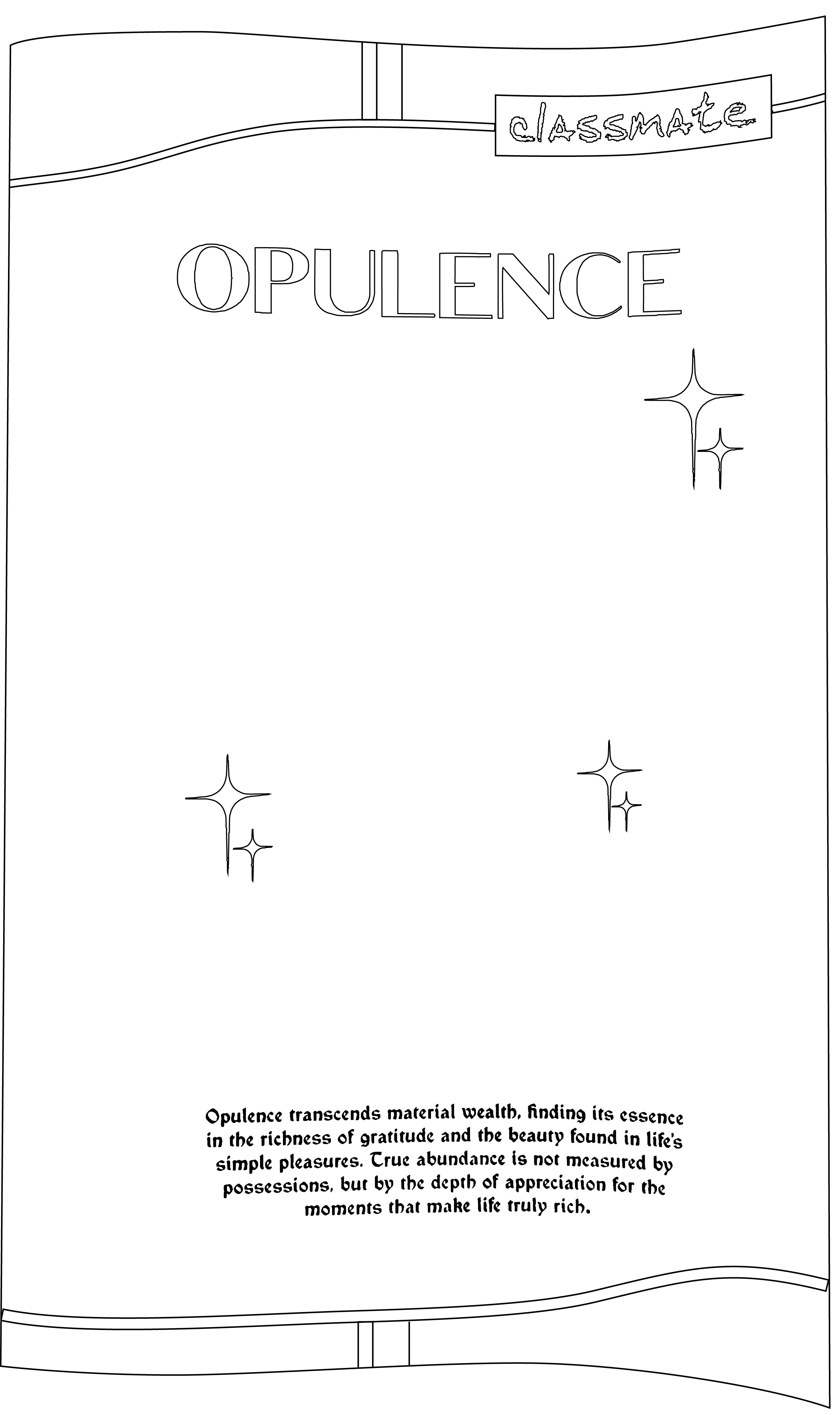
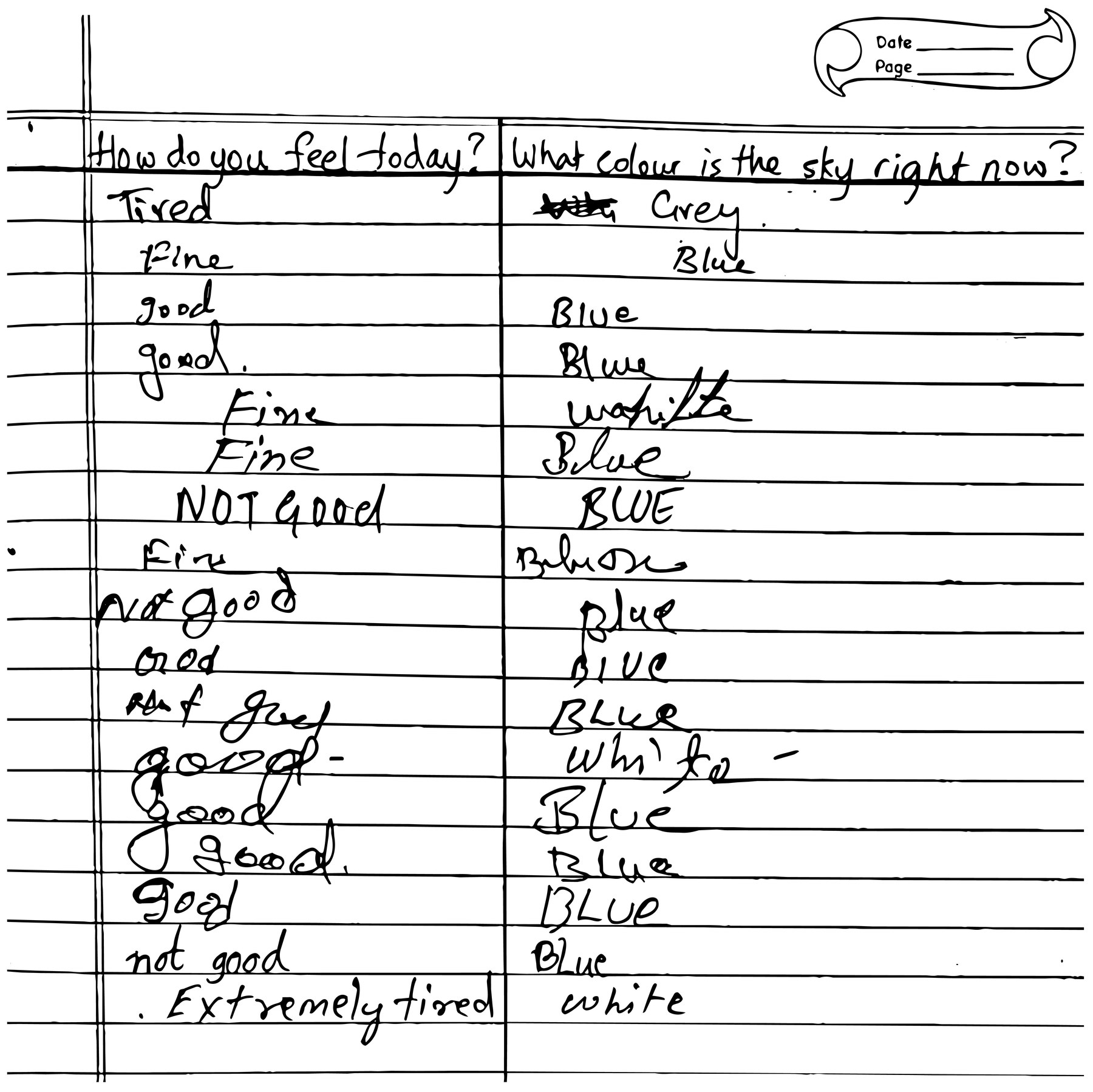
My first order was a book to replace the security guard’s register at the gate, where every arriving delivery worker has to sign in. I ordered a pink notebook with dolphins on the cover from the app, but what arrived was a blue book that said “Opulence” with the quote “True abundance is not measured by possessions, but by the depth of appreciation for the moments that make life truly rich.” In the first two pages of the book, where it would normally say “Time in”, “Name”, “Time out”, “Signature”, I wrote at the top: “How do you feel today?” and “What colour is the sky right now?”
I asked the security guard if he minded swapping my book with the real register. He was amused and a good sport about it. Later he called me every time someone came to report on what they did. “This one looked up at the sky before he wrote blue.”
The Meetings
Day 1
Srinivas. Zepto. Stayed for 0 minutes
Classmate Long Notebook (Design may vary). Delivered in 13 minutes.
Left the package at the door and ran away. I shouted after him, "Thank you Srinivas!" He looked back at me, startled, and then got in the elevator. I think he heard my dogs barking. [Next order, no dogs.]
Day 2
Abdul. Blinkit. Stayed for 1 minute
Cadbury 5 Star Chocolatey Bar. Delivered in 16 minutes.
Happy that I used his name, but didn't want to stay and didn't want a Five Star. Made eye contact and smiled. [Mornings seem like a bad time to do the project, everyone is in a rush.]
Yusuf. Blinkit. Stayed for 3 minutes
Dream Living PVC Doormat. Delivered in 23 minutes.
Called because he was on the wrong road. I said, "Please take your time." Said no to the Five Star at first, then ate it. Also accepted water. Looked perplexed, but sat down after being asked. I asked him how many jobs he'd done today: "3." He seemed happy to be asked. Left and at the door turned back and smiled.
Vicky. Zepto. Stayed for 3 minutes
Dream Living PVC Doormat. Delivered in 9 minutes.
Normally works in ‘stickering’ (car and bike decals). Has come to Bangalore for four months, starts every day at noon and then works most of the night - was in a hurry. Will go back to his hometown after making some money. Has problems at home so he had to sign up to do delivery. Said the work is ok but would much prefer to be back at his stickering job.
Chandra. Swiggy. Stayed for 6 minutes
A2B Take Away Ginger Tea 4 Cup. Delivered in 16 minutes.
Looked weary. He had a face mask on, he removed it to drink the tea he had brought. He was hesitant to take it but relaxed into his seat after that. "Customers never say hello." Before this, he worked as a clothing quality checker for 15 years. Had a factory job where he earned ₹30–40,000, now he gets much less. His company shut down because of the higher costs after the Iran war. The previous day he worked during heavy rains and earned ₹2,000, but the company fined him ₹500 because he was late to a delivery. He misses his old job. "I started at 9 am and this is the first time I've sat down [6:15 pm]” I felt devastated. I asked about taking a photo and he looked panicked. [no photos for sure]. Would occasionally look at his phone to see if the next order had come."It's very temporary work." [Tea seems to be the best.] "My family is long gone."
Day 3
Nagaraja. Swiggy. Stayed for 8 minutes
A2B Take Away Ginger Tea 4 Cup. Delivered in 29 minutes.
[Asking if I can ask them a few questions has worked out the best so far - they much prefer providing something to being offered anything. Looking them in the eye and acknowledging them also goes a long way. Avoiding eye contact is a way people avoid the discomfort of a transactional relationship, or maybe it’s because you will never see each other again.]
Refuses the tea he's brought, but then accepts when I say there is plenty. I struggle to open it and he helps me get it open and then I pour us both tea. It's considered insulting to refuse tea; it becomes a weird spot I've placed him in. Nagaraja says he has left the order open, because if he closes it he has to leave immediately, but he doesn't seem too stressed by this. He's worked for the company for eight years. He says he is "just managing." He used to work at a steel utensil shop. I tell him that's what my grandfather did. [I want to ask him about it more if we meet again.] I realize I haven't given him sugar for his tea. "That's ok, I have sugar all day, it's good to skip once in a while." I ask if there's anything I can do that would make things lighter for workers. "The tea and speaking to me is enough." I ask if he gets any benefits from the company and his eyes narrow. I assure him that I don't work for any company, and he looks like he believes me. He says he has land in his hometown that his father looks after. They grow rice. It's hard work, but if they don't do it, “how will we all eat? A farmer nourishes the whole world. We can't eat money, no matter how much we earn.”
Nagaraja asks where the dustbin is. My instinct is to say I'll take care of it, but I suppress it when he insists. I stay seated - he asks where it is, goes to the kitchen (deeper into the house), leans down and throws it away under the sink. I realize he feels more like a guest in my home as he is doing this.
[It feels like I’ve wandered too far from the project’s original intention - I don’t want to ask them about the work, I’m trying to provide a disruption from the work, and a moment of lightness. But I also feel like I have to send them away with something helpful, it can’t just end here. Some of them seem sad as the meeting comes to an end, like this has been great but they know it will never happen again. I don’t know if this is real or I’m just projecting. The questions are also leading places we already know - the work sucks. Next I will try just sitting with them, no more questions]
Sk. Blinkit. Stayed for 6 minutes
Ferrero Rocher Moments Chocolate Gift Pack. Delivered in 11 minutes.
[I order Ferrero Rocher, the most-gifted luxury chocolate. They have something called “Moments”. I imagine workers driving around with moments they can’t enjoy. I am still figuring out how to disclose the project. It’s hard to explain this as an artwork and I try to instead get to the essence of what it is. The app has created this relationship where we close doors in each other's faces and avoid eye contact, and I am trying to interrupt that by saying a proper hello and having a proper meeting.]
Sk accepts a Moment easily but with an uncomfortable expression. He shows me pictures of his three children back in his hometown - he’s been here for a month and his youngest is six months old. He says the work is very risky, the company is always pushing, go fast, go fast. He never drives in the rain. “The work is tough.” Sk is smiling and holding my gaze without looking away, and I am a bit uncomfortable. I start talking more about the project. I say “isn’t it weird how we don’t say hello and just shut the door in each other’s faces?” He doesn’t answer and his eyes harden for a second, but I can’t figure out why. When he leaves I try to give him some Moments for his children. He takes two but says they won’t last until his next trip home.
Rocky D Fernendiz. Zepto. Stayed for 7 minutes
Dream Living PVC Doormat. Delivered in 19 minutes.
Rocky seems relaxed. He is wearing a hat with a monkey on it. I ask him about it and he says he got it from Flipkart. Sits down but refuses everything I offer. Later tells me he only wants to eat non-veg. We talk about how other vegetarian workers might be uncomfortable so I probably can’t have it waiting. He is doing delivery work to get pocket money for himself and his mother. He says his mother buys groceries with it, and he buys shirts and pants and takes his friends out for tea. I ask if he has a girlfriend and immediately feel like I’ve overstepped. He laughs and says no. I say “that would be expensive”. He works part time after college. Says he could never do full time: "It's too hard." He only goes to one Zepto location nearby where his friend was already working. I tell him it's likely I'll see him again then. We take a selfie together. "See you soon!" It feels like I've made a friend. It was only 7 minutes.
Pasha. Swiggy. Stayed for 6 minutes
Take Away Tea 4 Cups. Delivered in 18 minutes
“Hi Pasha, would you like to sit for a minute and have a cup of tea?” Pasha says he’s just begun for the day and needs to leave soon. He sits and drinks some water. It’s the day after a big protest in the capital, I ask if he’s heard about it. He says he hasn’t been concentrating on it, but then talks about it for several minutes after I reveal that we are on the same side. He says, “everyone is human, everyone is the same”.
Amjad. Zepto. Stayed for 0 minutes
Homestop
Ceramic “Besties”
Coffee Mug. Delivered in 9 minutes.
I say “Hello Amjad, would you like to come in”. Smiling, he declines and leaves.
Day 4
Aslam. Blinkit. Stayed for 9 minutes
Mini Samosa Pack of 6. Delivered in 17 minutes.
[2nd attempt to keep it light. Trying new disclosure - can we meet you for two minutes]
Aslam is from Bihar and is wearing a t-shirt that says Fear of God. He says he chose it because he is afraid of God. He accepts a Moment from the table, but only after I ask twice. This is the pattern with everyone so far. The chocolate Five Stars have been universally declined, maybe a subconscious dislike of the rating system. I have retired them and have started to find stars sinister myself, after a few days of hearing their stories. It’s a hot day and Aslam is sweating, he accepts water and a seat easily. I try to talk about the weather in my new effort to keep things light. He says Bangalore has had weird weather all year but it’s still better than most towns, and his town. I ask him his favourite song he says he doesn’t have one, but that he likes Shahrukh Khan and Salman Khan movies and his favourite movies are Chaand Ke Paar Chalo, and Sanam Teri Kasam. I ask if there is anything he would want to ask a customer, since I’m sitting there. He misunderstands what I mean and says “sometimes customers mistreat us, or get our ID’s blocked”. [Now I can’t stop myself from asking more, plan to keep it light goes bust.] He says it's only happened to him once personally and that the company keeps recordings of every call. He couldn’t work for days while his ID was blocked, but he challenged the complaint and after they heard the recordings they realized the customer was lying. They had said he misbehaved and used bad language, but he hadn’t. This has happened to his friends too. I ask how many friends he has, he says there are about 50 workers at his fulfillment store but he’s only friends with about eight. He says the workers inside the store aren’t his friends, and that it’s harder labour in one way, but that delivery work is taking more chances - the driving is really risky. The store workers are salaried employees but if they delay picking a package or dropping it off, their pay is deducted every time.
I ask if he gets breaks to pray and he says he goes to the mosque and freshens up and then continues working, and that it's not a problem. We’ve been talking a while, I ask if our order is still open. He says yes, if I close it I have to rush back to the store or my ID will go offline. He doesn’t look like he wants to go, we keep talking. I ask if the app feels like his boss, he says it does. “Two years ago it wasn’t that strict, we could take an hour's break without a problem. Now it is much more strict.” I ask if there’s any way to raise a complaint about the app and its rules. He says the local stores have a manager but they can't do anything, “everything comes from higher up. We can also raise a complaint about customers, but never about the company.” I ask about medical benefits. He says his friend got hit by a four wheeler and he points to his collar ‘this bone was fractured”. It cost around 35,000 rupees. The store manager said to pay and that the company would pay later. So we all loaned him the money together and sent him back to his village. “Did you get the money back”. “No, the company never paid”.
[another worker Ahmar comes in with another package from the same app. Totally changes the energy]
Ahmar comes in and I introduce him to Aslam “have you guys met before?” It’s feeling even more like a hangout now. “No, you must be from the Frazer town location”. “Yes, I work there”. “I’m at the Shivajinagar store”. It looks like Aslam has to go. He says it was really nice meeting you and talking to you. Ahmar takes a Moment after I insist, and also leaves.

I decide to make something for the workers to take with them, and extend the relationship beyond 5 minutes. I will make them a card with their name in it, printed in the time between them accepting the order and their arrival (usually 5-20 minutes).
I am from the irony generation of the nineties, and have studied design with mostly Dutch professors. But I want to engage with sincerity – in this project I am trying to make sincerity a practice and I try to throw off my own training and impulses and think, what would be truly meaningful to them. It seems like minimalism and millennial grey have arrived in tandem with ten minute deliveries. I look at roses and happy typefaces. I order 3D stickers filled with glitter and shaped like roses. At first it's forced and then I find myself starting to genuinely enjoy all of it.
I find a free typeface with flourishes and leaves growing out of it that I really like and a default system font (Lucida Grande) that looks friendly. On the front of the card, I write “Thank you for coming” and leave a space for the worker's name. I have three variations of image beneath the text: a sunset, a steaming flowered cup of tea, and a rose with falling petals, all with feathered edges. I write “I am sad to say goodbye” on the back, and mean it.
I test the card on my mother and she loves it. She is from a flower age. Sincerity success.

Inside the card I explain the project, how I will share it and also include a rainbow-coloured QR code linking to resources for workers in Kannada, English, Tamil and Hindi – unions, worker organizations and insurance programs.
Day 5
Dyavarappa. Zepto. Stayed for 0 minutes
Dream Living PVC Doormat. Delivered in 20 minutes
It’s too late to invite them inside. Their name is hard to remember, long and I’ve never heard it before. As I head to the door I say it over and over so I don’t forget. Dyavarappa. “Hello Dyavarappa.” Dyavarappa looks tired and returns a quick artificial smile, hands me the package and leaves.
[The welcoming is becoming an algorithm. Make eye contact, smile, greet them using their name. Offer them water and the bathroom, tea. Take screenshot of product in app, write notes, note down delivery time, how long they stayed, repeat.]
Day 6
Rafiquzzaman. Swiggy. Stayed for 1 minute
Ginger Chai Uniflask. Delivered in 38 minutes
[The first meeting of the day is always weird and takes a strange exertion of will to get into. I take a deep breath before placing the order.]
I have the inside of the cards already printed on a set of ten sheets. I order the tea and five minutes later a person with a very unusual name with 12 letters in it is assigned. It doesn’t fit in the design I’ve pre-made and I have to scale the name down.
The printer is refusing to print on the nice paper whose brand name is ironically ‘Nice Paper’. I have to keep on pressing the paper button. It finally prints half of it and spits it out. I realize I have “letter” selected instead of A4. I print it on thinner paper and it works fine. Switch back to Nice, stuck again. He is 8 minutes away. After what feels like 50 attempts and misprints I finally get one usable copy, it looks almost like a store bought card except the inside text is a little off center.
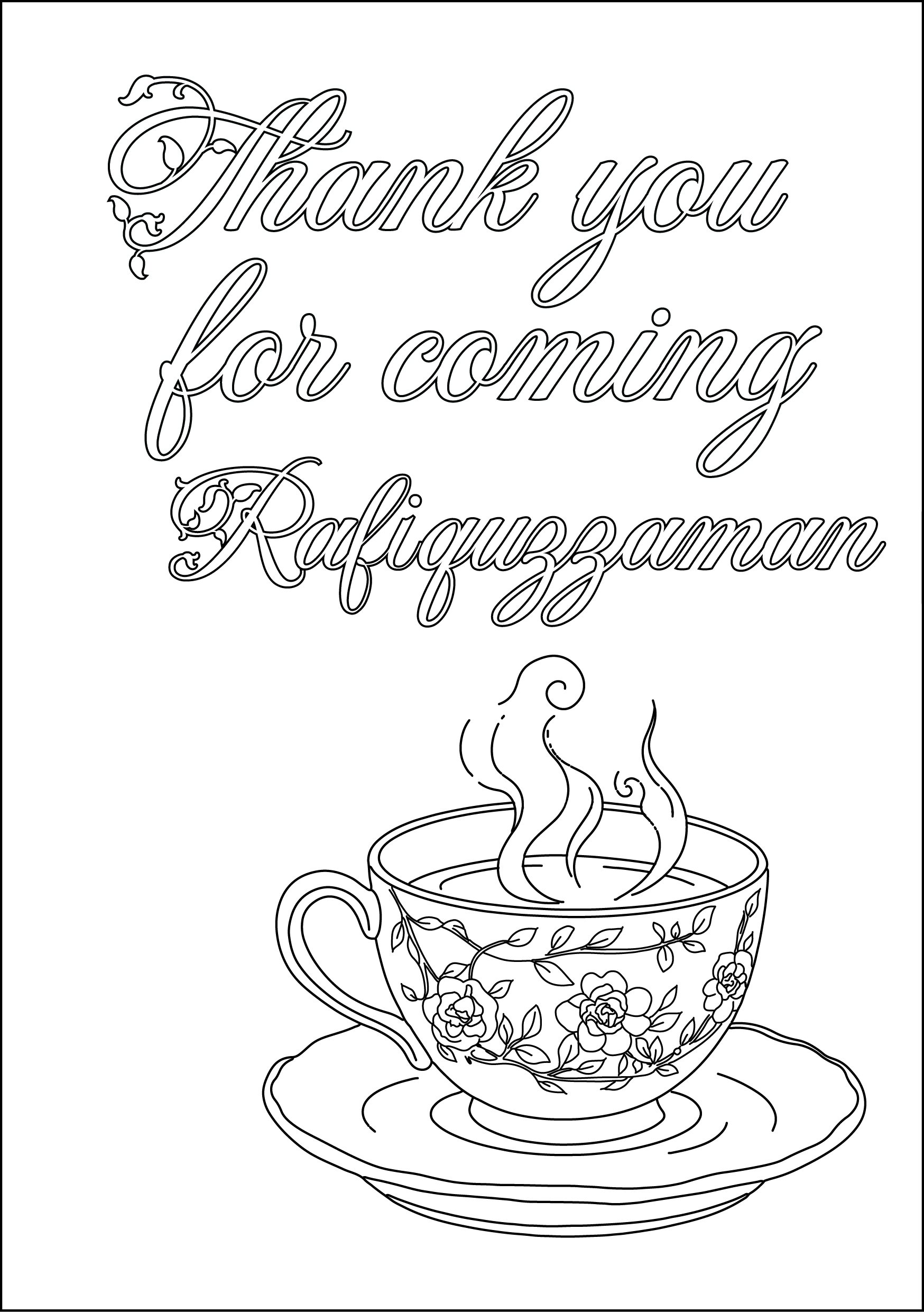
Rafiquzzaman seems quite reserved and in a hurry. He is refusing tea, doesn’t want to sit, but finally takes a chocolate. I hand him the card with the front facing up (“Thank you for coming Rafiquzzaman”). He sees his name and for a second looks flabbergasted but then forces his expression normal again. He takes a step forward like he doesn’t know whether to leave. He smiles awkwardly, says ok, thank you and walks out.
Arif Ahmed. Instamart. Stayed for 10 minutes
Itsy Bitsy Handmade Stickers Pastel Purple 3D Jewel Butterfly. Delivered in 12 minutes
[I am determined to succeed in keeping things relaxed]
The nice paper fails fully this time and there’s no time to mess with it. I print on the thin paper and it looks way less convincing as a real card.
Arif is from Bangalore, and lives in my neighbourhood. An actual neighbour. We talk about the weather, how he gets his haircuts on Saturdays. I ask if he watches TV and he says he has no time, he has to work all the time (6am to 9pm). He says he’s putting his kid through college and in two more years, he will relax! He smiles broadly. He says he’s 60 but looks about 45. He says he “has no habits” so he has stayed young. “No cigarettes, no wine”. He says he got a shock when I called him inside. He says he is the longest term Swiggy worker and has been with them since they started. “I got a pass for the lockdown and could drive anywhere” he says proudly. He says it was fun to drive around on empty streets. He gets up to leave, I’ve had his card face down on the table and turn it over and hand it to him. He looks at the card but doesn’t seem like he registers it has his name, and leaves. [Cursive font with flourishes was probably a bad idea]
Bikram. Zepto. Stayed for 2 minutes
Samosa Party Bucket. Delivered in 23 minutes.
I order something from far away to give me time to deal with the printing. “Bikram” accepts the order – I change the name on the card, insert the nice paper and press print, holding my breath. It comes out perfectly on the first try.
In the extra time waiting I start adding stickers to the front. Butterfly. Holographic silver shapes. Smiley face.
Bikram refuses the samosa he’s brought with him, says he’s already eaten. Tea too. He says he can sit for a minute because it’s a slow day. He’s from a small village in Nepal, where he was an electrician. We sit in silence smiling at each other and then he gets up.
He walks out holding the card in his hand, I watch him walk down the hallway. He doesn’t look at it.
The Party
The party starts at the gate. The morning of the big, day-long party I set up a system of uniform green welcome mats as markers through the building leading to my door. I make a sign I hang at the door with text and colorful streamers. I place a welcome mat at the gate, one in the lobby pointing towards the elevator, one welcoming them into the elevator at the doors, one inside it, then two along my hallway on the third floor, and finally two at my door, one outside and one inside. Maybe overkill. I also continue the signage inside, placing one at the door to my restroom, indicating it is welcome for use. I offer the restroom to almost every worker who comes in, but no-one ever accepts.
I set the tip on all the apps to 101 rupees, an auspicious gifting number (in Hindu culture but hoping everyone will appreciate it). It’s normally a physical one-rupee coin given with cash in an envelope, this is the first time I’ve given it digitally. I look it up and the extra rupee carries multiple ideas: zero symbolizes an ending, adding one wishes the recipient growth; an odd amount can't be divided, so the blessing stays whole; and the coin is a small debt that promises the giver and receiver will meet again.
On the day of the party I have someone helping me out - Adit, a student I met while teaching, is 22 and closer in age to many of the workers. We have put together 40 gift bags for the workers with a sweet and savory snack, a “Moment” and a version of the card without their own names.
First order of the day is A2B Take Away Ginger Tea. Gulzar helps me open the tea and drinks a cup. He tells me and Adit that he has done a Bachelor of Fine Arts. Adit and I look at each other, thrown by this development. We have invited an artist into our art project. We tell him that’s what we are doing too, and that the party is part of a project. I can’t tell much about his expression when he hears this. He leaves with a gift bag before I realize we should ask him more about being an artist. Adit runs after him but sees him driving away on his bike.
[The welcome mats are looking too uniform and not festive but it's too late to change.]
Ibrahim is from Bihar. He is very happy to sit and take a chair after politely refusing for a second. He smiles broadly, making good eye contact. Says it’s his sixth day on the job. Before this he did window glass fitting. He says he doesn’t like listening to Hindi music. Doesn’t like movies either. He studied at an Islamic school but didn’t want to become an imam because it pays too little. Says parties are allowed, but no current music. He only likes praying and working to help his parents. Doesn’t seem like a partying guy but sits for a long time looking down and scrolling through his phone. Adit has spilled sugar everywhere while making himself tea and is now sweeping around Ibrahim’s feet, who is sitting in a portable camping chair with drink holders that he has just delivered. Adit stops sweeping, hands Ibrahim a gift bag and he leaves looking happy.
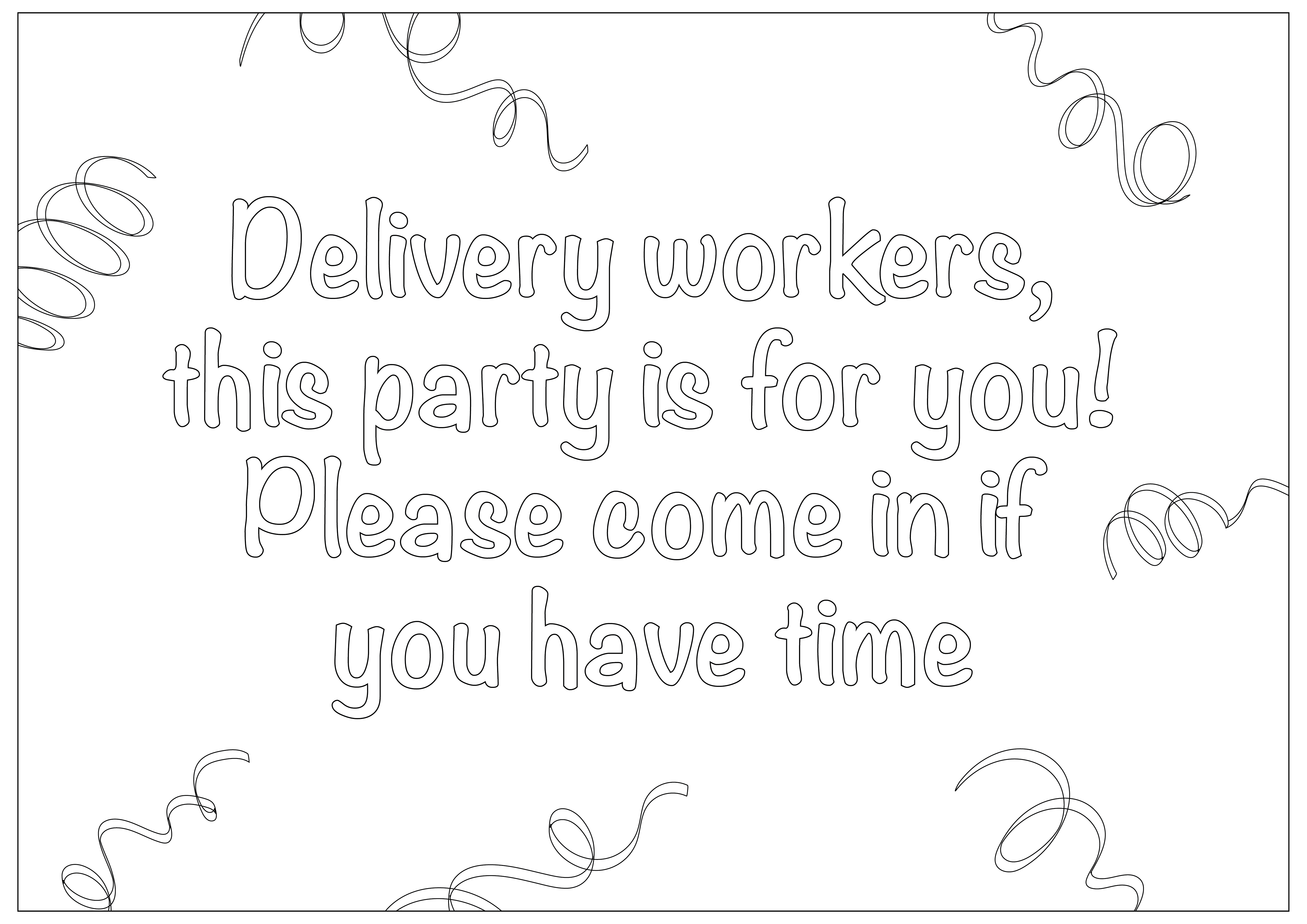
[The first few workers have missed all signs intended for them. It seems like they are in a rush and mostly looking down at their phones as they walk. I go out and add some 3D stickers to the elevator sign that make it harder to miss - roses, smiley faces and some butterflies].
Venkatesh brings a blue foil curtain which he helps me hang at the door.
He has been working as a delivery driver for 4 years, but only 7 months at his current company which he likes better because it’s closer to his house. Nazrul arrives next - he has brought a brown stool with a giant hole in the corner of the seat. I don’t complain to the company. I remove the plastic from the stool and he sits down and accepts tea easily. He seems more comfortable because Venkatesh is already sitting with me. I ask if they will take a holiday the next day - they say the company doesn’t give holidays, and that holidays are also big earnings days. It’s Nazrul’s 15th day in Bangalore, he has moved from a village near Calcutta, says he preferred moving far away because if he was near his village he would keep wanting to go back to see his children. Nazrul has to leave for his next order, I give him a gift bag and he leaves happily. The conversation switches to English. Venkatesh says his wife brings him food on foot to the fulfillment center so he doesn’t have to take time out for lunch. He usually sits in a customer’s basement and eats it. He wakes up every day at 2am and does a shift from 3am to 1pm, seven days a week. He rarely takes holidays because if he does his wife and kids “won’t have food to eat”. He says if they log out even one minute before the end of the shift they lose all their incentives, so even when he has no orders he just sits and waits. He lost his previous job at an event management company after he got jaundice and took a long leave. At his old job he got bonuses, his kids' school admission was paid for, and they’d give him petrol money. He tried to go back but they’d already hired a permanent replacement.
I ask Venkatesh if he knows Rocky, who works at the same center. He says that he doesn’t make friends, that he just picks up his orders and doesn’t talk to anyone. He has never seen the store manager though he’s been there 7 months. Hundreds of workers work there. I notice he has a tattoo on his neck, I can see three large stars that continue below his t-shirt. I ask him if it’s a five star rating - he laughs and says “no I got this when I was 17. I am only 35 but I have a grey beard, no one will hire me, they don’t believe my age and say I’m too old to be an office boy.”
After each delivery he has only 10 minutes to return to the fulfillment center. He has kept the order open for a very long time [we are really deviating from my plan to keep the parties short and not disrupt their work]. I wonder if he will be penalized but he says no no it’s fine. He seems to be enjoying being here despite the heavy conversation. He says he’s feeling very happy about being invited in today. He says customers never show their faces, some tell him to leave orders in the elevator and press the button as if they don’t even want him to be in their elevator. Adit joins us and tells him he moved to Bangalore from Pune for design school. We talk about how prices have risen so much in the last six months because of the war - petrol is now 110. I say I remember when it was 40, Venkatesh laughs and says yes that was when we were young.
[For a moment it starts to feel kind of like making small talk at a real party.]
Venkatesh says he likes the idea of a work party but doesn’t know if others will. He says he doesn’t listen to much music. I ask him about company uniforms, I’ve noticed so far not one person has been wearing it. “They make us wear it and take a selfie every hour. It’s made of jersey and too hot so I just keep it in my bike and only wear it for the selfie.” I imagine thousands of tired workers, every hour putting on these uniforms for pointless selfies some white collar consultant has decided is important for their branding. Venkatesh gets up, chooses a pink gift bag, says his daughter will like that, and we wish each other happy Dussehra as he leaves.
[Venkatesh has stayed for about 25 minutes. I need to invite more people and produce a more festive mood]
[It’s the day before Dussehra and most of the decorations are sold out. I order Welcome Home Baby Boy]
Aslam refuses and then accepts a Five Star I’ve missed removing, the first to take one and the first to eat the chocolate while sitting rather than just taking it with them. He is a local and worked as a chicken cutter for 12 years but tells me he left because he didn’t like the smell. The story seems a bit suspect, after 12 years you’d think he’d be used to it. I ask what he does for fun, he says he doesn’t go out or go to the movies but listens to Hindi songs and looks at Instagram and Facebook on his phone. He later admits he has fought with his brother (who owns the chicken store) and has moved in with his sister. His family didn’t approve of the girl he wanted to marry - he is also not speaking to his parents. I ask him about the girl. “Now that’s also broken off.”
Shivshankar is from Bihar and has been here for 1.5 months, has come alone to earn money. He says Bihar has nothing, no development, and that he owns a lot of land there. “If there were companies there we wouldn’t come”. I find out the task has been redirected to another app that has a limited set of restaurants and he only works for them, not for the company I ordered with. The app is asking him to take a photo of his bike to prove his order has been delivered, so he gets up and leaves.
Irfan sits for a minute, says he’s just had a samosa and tea but takes a KitKat. He accepts a gift bag, says thank you and goes on his way.
Nawaz and Bikash arrive around the same time. Nawaz comes in first. I offer him a samosa and he declines. He and Adit struggle to open the tea and laugh. He’s a local and lives nearby. Bikash comes next and also declines tea. I ask if he’ll have a samosa and tell him they’re hot and just came, he still declines. The samosa box says WTF? on it for some reason. Bikash is young and upbeat. He asks where I’m from and I answer Bangalore. [Finally someone is asking me questions]. I try to explain what we’re doing, how the apps are designed so the order arrives and the people disappear. As the day progresses I become better at explaining and even crystallize to myself what this project is about, through this process of explaining. Nawaz says “This is the first experience like this and I’m feeling very happy”. Bikash started inside the store, he’s the first person I’ve met who has done both. He says he was doing “packing and picking”, before he had a bike. Nawaz says both delivery and in-store are the same, but Bikash (who has actually done both) disagrees. “Delivery is much better. In the store, you’re constantly running up and down between floors, picking packages. And in delivery you earn much more”. I realize one of them has brought cokes. Bikash says he doesn’t like coke. I ask him what he does for fun. So far everyone has said they don’t have fun or there is no time for fun. Bikash says “We enjoy and party.” His friends have small parties at home, “cook food, eat and roam around.”
Nawaz looks a bit unhappy that I’m not giving him attention. I shift back to him. He says he takes his family to the local market or garden nearby. I tell him about the free museums I know of in the city. He says Sundays he can’t take off because Sunday they get a bonus. I want to ask when he can take his children out then but decide not to. They both talk about day versus night shifts. Night shift pays more but there are drinkers on the road and it’s perilous for bike riders. They also get cheated by customers much more often at night. They say people tend to cheat outsiders, if they open the door and they see someone from UP or Bihar, they take the package, close the door and don’t pay. They’re scared to do it with locals. The company doesn’t compensate them. “They say it’s not our issue, not our problem.”
They say no-one ever says hello. Nowadays no-one has time. Everyone agrees things were better before the apps.
Nawaz says he used to work for a telecom company. He was in Saudi Arabia but had to return during the lockdown, and then his contract was over. After that he couldn’t get a visa to return. He says he wouldn’t want to go back now, everything is hard there with the US war. “It’s terrible there now.”
Bikash says he studied political science, history and Bengali, but had to stop because of money problems at home. His friends are telling him to return and finish and he’s thinking about it. I ask him what jobs people get after doing political science and history and he says property work, which I don’t understand but I let it be.
There’s a lull in the conversation and Bikash and Nawaz get up. Nawaz says “I give you Duas, I will pray for you.” It’s very touching but I also feel like all day I am receiving all this gratitude because no-one understands I’m doing this for a project, and am not so noble or generous.
[Party is so far too staid and too much discussion about work. I shift gears to inviting more people (by ordering more products at once) and try to have a lighter party spirit. The atmosphere begins with the host.]
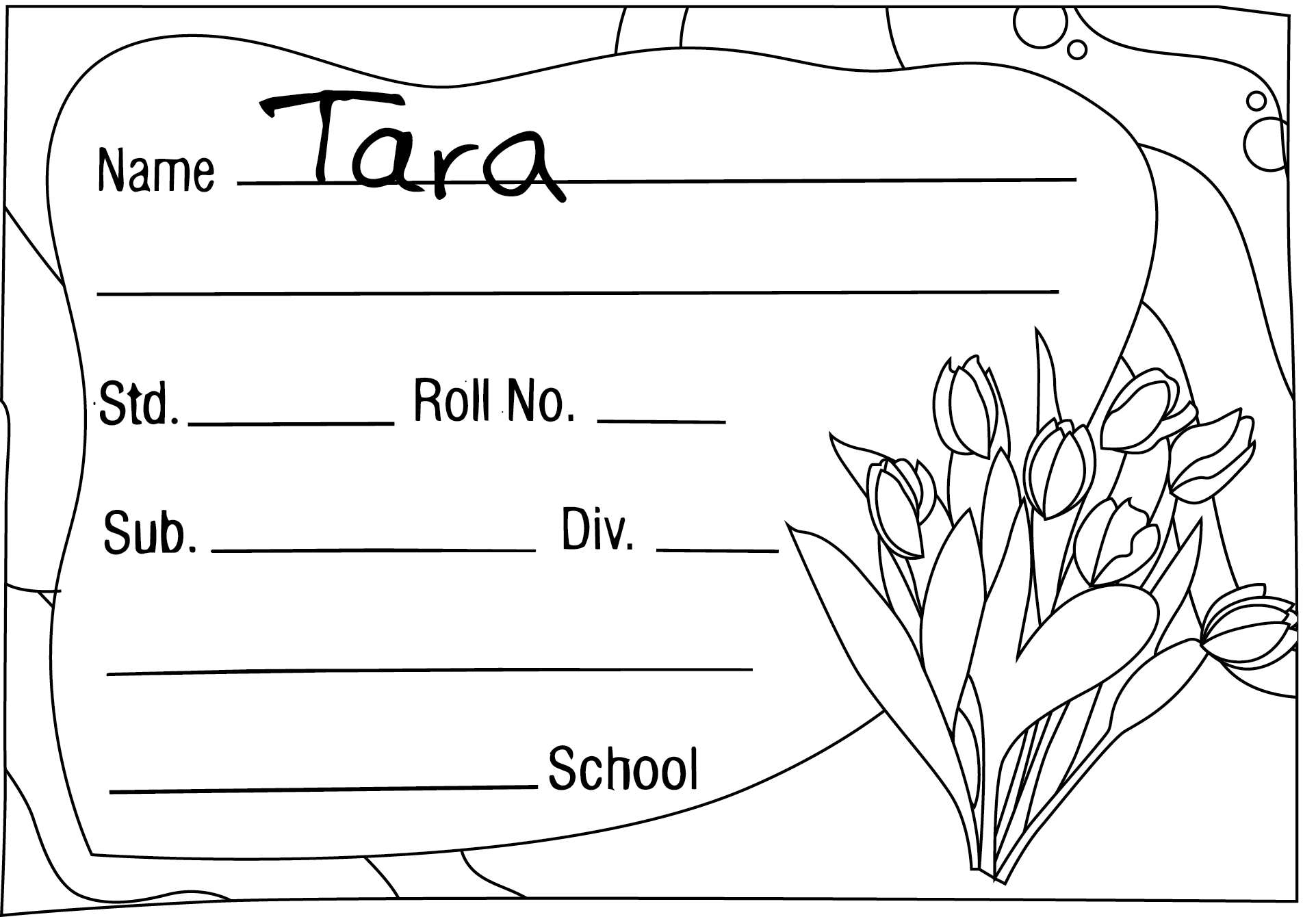
Adit and I write our names on sticker name tags (the ones for school kids where you can write “School” “Class” etc). Mine has tulips, Adit’s has two yellow roses and one pink rose. We peel them off and stick them at the top of our shirts.
Amit brings more tea. He refuses anything, I ask if he likes sweets he says yes I do, I say “this party is for you” and he chooses a KitKat. I ask if he’ll have tea and he looks a bit overwhelmed, at this point the table is covered in options (coke, juice, tea, Choki Choki, KitKat, Fruitella). He takes a Frooti (mango juice box) but just holds it in his hand. This turns out to be the most popular drink of the day. I ask him if he likes riding his bike. [Trying to keep it light]. He says he does, that it’s a petrol Scooty. He says he likes to drive fast and laughs. He tells us about his friends and siblings. I ask again if he’ll have tea and he accepts it and sips it. He doesn’t take days off and so he doesn’t hang out much with his friends. Amit picks up a chocolate coin off the table and asks me what it is. I say it's chocolate and he takes that too. He gets up to leave with a bunch of stuff in his hands and accepts a gift bag. He holds everything in one hand and with the other gets into position to take a selfie of the two of us, without asking permission. I oblige and smile for the camera.
[Throughout the day I have to keep repeating “this party is for you” which is mainly met with a bewildered, muted acceptance.]
Sahidul comes in for a quick second, bringing “Welcome Home Baby Boy”. Says no thank you to tea, accepts a gift bag and leaves.
Vikas sits for a little bit, accepts a Frooti but doesn’t drink it. He is in his third year of college and after is going to do an eight month hardware course. He wants to learn how to repair CPUs and start a computer repair shop. We talk about how AI probably won’t be able to replace computer repair anytime soon. He says most of his friends do the same work part-time, one at Blinkit, one at Flipkart. I am majorly startled by a blaring sound and loud voice that comes from his phone, which seems to be in his pocket: ATTENTION DEAR PARTNER YOU’RE DELAYED IN DELIVERING THE ORDER PLEASE DELIVER SOON. He doesn’t look fazed but I ask if he needs to go. He says ok and “thank you for making this special” and leaves with a gift bag.
Irfan is back again. He looks familiar but I ask him to be sure. Once again he can’t stay. I ask semi jokingly if he wants another gift bag, he declines and says that he has another order.
[Adit and I hang just the “welcome” part of Welcome Home Baby Boy, above my kitchen island, along with some blue bunting with images of gold crowns on it]
[I turn on a Saregama speaker and skip the first few sad songs that play until I find something upbeat. The Welcome Baby Boy came with white and blue balloons, the white balloons filled with gold confetti. We inflate some - some are pushed into a corner near the gift bags, others we stick on the wall. Between the balloons and the music I feel like I’m starting to get into party mode.]
It’s been an hour since I’ve ordered pizza for the party. I open the app. “Asha has picked up your order.” I’m really excited that we will finally meet a woman. But every time I check, she isn’t moving on the map. It’s been an hour and a half - Adit and I are starving and finally start eating cold samosas from the table. Asha still hasn’t moved, it says she’s right down the street from the pizza place. I give up and order another pizza and ask customer service what to do about the delayed order. They cancel the order and I get a refund. I can’t give Asha a rating and for the first time during the project I break my word about giving every worker five stars.
Manju arrives with pizza and says in Kannada that he can’t have sweets but still accepts a Frooti. Manju has been doing delivery for ten years and rides a Bajaj CT 100. Another worker has walked in at the same time as Manju, left more pizza and slipped out before we even notice. I realize that the cancelled pizzas have somehow still been delivered. I keep noticing how the apps are including a “free sample” or “free gift” and now I also have two free pizzas. All day long the workers have been telling us about how they get penalized, while as a customer I keep benefiting.
The Saregama speaker keeps playing old sad songs. I switch to a bluetooth speaker. Someone asks me to play Oo Antava Mava, a Telugu song from Pushpa. Now it REALLY feels like a party, to me at least. The song is a crowd favourite. [I look the song up later and discover it’s a “satirical critique of the male gaze”. I’m learning so much through these parties.]
I feel myself start to loosen up with pizza in my hand and the music pumping. I stand at my kitchen island and start talking to a worker with half a slice in my hand, as I chew, and realize that my new relaxed vibe is putting him quickly at ease.
It’s the last day of Navrathri and I order some discounted Dandiya sticks. Zachariah, a tall peaceful guy wearing a sweatshirt that says WANDERLUST, walks in. He sits down at the table with a big smile and I sit down next to him. He says his favourite song is Appadi Podu. I ask the spelling and type it out in my phone. I cant find the right one. “Is it from Ghilli?”. I find it and press play. Sahidul, who had come earlier but couldn’t stay, walks in with “Party Propz Hooters and Noise Makers” and says he has targets to meet and sits for just a few minutes. Rakesh comes in and we ask him to sit - he asks if it’s a birthday - Zachariah says, “it’s a party for us”. Rakesh says he will only have a chocolate, but refuses to choose. “Give me whatever”. Yogesh comes in and joins us at the table. I hand out party hooters. Sahidul blows one but not very hard and a small and odd sound emerges. I feel a sense of panic at the weird vibe I’ve produced. Zachariah says he will have pizza and accepts a slice of very cold pizza. He eats a bite and leaves it on the table and doesn’t have any more after that.
Azeem walks in and asks if it’s a birthday and sits down confidently. He reaches across the table and takes a hershey kiss and accepts a party cup Adit fills with coke. Azeem starts to talk about the weird situation we find ourselves in. “Everyone is embarrassed”. Yogesh says “Yes, totally embarrassed. When I came in I thought they must be calling the wrong person, and then they offered biscuits!” I explain the project. Zachariah says softly “thank you very much”. Azeem takes over the interaction: “Shall we all share something for 10 or 15 minutes?” I say ok and he goes first. He says he’s not a full-time delivery boy, and that he’s an engineering student and he’s doing many part time jobs, one of which is that he owns his own biryani hotel (restaurant). “Wow!” I reply. I ask how many part time gigs he has, he says four to five. He says his hotel is near a local hospital, next to some mutton shops. “I own the whole building”. I am finding the story curiouser and curiouser and start asking clarifying questions. He says he is part of a joint family of mutton merchants or Qureshis who have five shops side by side. He says he also owns five factories. “They’re my dads factories but I take care of them”. “What do the factories make,” I ask and he says they do carpentry and furniture polishing and also sell paint. Yogesh unpeels a silver chocolate coin and eats it. Azeem wants to keep going but I think we should give someone else a turn. Zachariah says he is a BBA student and doesn’t seem to want to talk anymore. Yogesh is itching to go next and starting telling a convoluted story. He says he had an agency that ran three banks and kept telecallers, and that it shut down during covid. And that he lost his entire business, and 25 lakhs (USD 25,000). It all gets progressively more complicated and I don’t think anyone is comprehending much. Something about how he keeps waiting for an application to be approved (I think for a loan) and how the zonal head keeps reassuring him.
Rakesh goes next and talks about how he has two sons, one in college, one in tenth grade, and how expensive life is. Appadi Podu is still playing, “an upbeat Kothu dance anthem that centers on carefree celebration”. Rakesh hasn’t been home in two years, he is repaying a loan he took to buy a house and says that’s where his problems began. I’m concerned about how long they’ve all been there but Yogesh says they have an hour to get back, which is different from the 10 minutes someone has said earlier. Rakesh gets up to leave, I tell him the gift bag has a card in it that explains the project and has my number. Another worker arrives with roses. I ask Zachariah about the cold pizza and he doesn’t respond. Adit laughs. Yogesh asks me to go next. I tell them I grew up in the house we’re sitting in, that I’m an artist and studied graphic design. That I make work about working. “Great”, Yogesh says. I tell them I was Adit’s professor. We discuss the problems with delivery apps and the gig economy. We talk about how in the days of cash how everyone used to tip. Everyone at the table says they don’t get tipped at all. Ever. Yogesh says it’s all going to keep getting worse. I tell them how a friend of mine is a gig work researcher and the new programs for workers she’s been telling me abo– Yogesh’s phone alarms: “Delivery partner: Blinkit. Deliver quickly.” He’s left the task open too long. He says they will call next. I ask what he will say, he says he’ll tell them he’s just giving the parcel now.
We talk about how workers have no benefits, I tell them a story from a previous day, about how the worker who broke his collar bone and loaned money was never reimbursed. The tone has become more serious again, but in a nice way. There’s real camaraderie in this group. Azeem talks about being an employer. He says he would make more profit if he fired all his workers but doesn’t because they need the work. But the apps are heartless. He says that if they login even five minutes late, they lose the entire day’s incentives. Or if their phone runs out of battery, they lose all of that day's incentives. Yogesh receives the call from Blinkit, asking where he is, I hear him explaining. He hangs up and I jokingly say I’m going to tell the company he didn’t deliver the package. This produces the biggest laughs of the day from the whole group, except Yogesh, who says please please don’t, I say no no I’m just joking and have to reassure him multiple times. He says that if he gets 3 complaints his ID gets banned permanently. Termination. I ask how come everyone I’m meeting hasn’t been doing the work very long. They say that it’s really hard, but that Nepalis and UP people do long 16 hour shifts, 7 days a week. Yogesh says he worked 10 hours the previous day, Zachariah says “some people work for 17, 18 hours”. Azeem says how many hours will they sleep then? [Even within the workers there’s a huge range of struggle and of class]. Yogesh says “they must have a commitment (loan).”
I ask the group if this is a weird thing to do, try to have a party when they must all be so tired. They all say no, only some are tired, some of us work part time. [At this point they’ve all been sitting for maybe 20 minutes.] We talk about how ridiculous the 10 minute delivery promise is. “Who needs anything in 10 minutes?” Yogesh says someone ordered sixteen items the previous day, and selected “don’t ring bell” and “don’t call” at the same time in the app - he holds up his hands and says “what do I do then? Others ask for change but we won’t know how much to bring!” Azeem says a customer once shouted at him for taking too long (his mobile had no signal) and threatened to throw the package in his face. He told the customer he didn’t want his money and left. They tell me the company records all their calls, they can’t ever raise their voice or be disrespectful. Adit talks about working in the Netherlands as a delivery worker for an app. He had a fixed wage per hour, 1100 rupees (11 euro) per hour. Yogesh says “you can only work 20 hours right” and Adit says yes. They all look envious. They ask if it’s cold in the Netherlands, he says yes. Yogesh asks where I teach. He says he has all the professors’ phone numbers, and shows us, scrolling through the names on his phone. I recognize some of them and am amazed. I try to figure out how he has the numbers but once again he is vague. Azeem asks if I have a start-up and seems to have missed everything I’ve said up to this point. I say no I’m just trying to learn about work, Yogesh says it’s his 4th month and he feels very guilty, he had 40 employees and let them all go. Everyone seems like they’re getting up to leave. We decide to try the party popper before they leave, but no-one can make it work. Zachariah looks like he’s about to do it but he’s pointing it at my face, “point it up!”. Finally he figures out how to twist it in two directions. There’s a huge bang and confetti flies all over us. Everyone gets up, takes a gift bag and leaves.
A few minutes later, Azeem walks back in. He says he wants to talk to me alone, I feel a bit nervous. He asks if I have a job for him at my start-up. He says he wants to be an entrepreneur and that he’s studying robotics and AI. He says his family has always been in real estate and that he wants to earn 1-2 crores (100,000 - 200,000 Euro) and then start his real estate business, and retire in 15 years. He looks about 21 years old. Once again I explain I don’t have a start-up but I take his number and say I’ll talk to a friend who does real estate about whether she has any openings.
After they leave, I rearrange the table and decorate it with the rosebuds.
Sulaiman arrives with the carrom board (classic game played with wooden coins, sort of like pool with fingers). We move all the plates I’ve just decorated to make room. Sulaiman sits down at the table and tells us he is an AC technician on the side. Or that this is his side gig, unclear. Vijay comes in next and takes the remaining chair. I ask if they want to play, they say ok. They are very stiff and almost sullen, but don’t seem to want to leave. Each is also bearing an extreme haircut. Sulaiman sips on a juice box. The board is shaking a lot, we try to stabilize it and finally stop with the board sloping but no longer moving. I ask if they want to play singles or teams. Vijay who has been quiet until now, barks, “teams”. The teams are me and Sulaiman against Adit and Vijay. Adit starts powdering the board and Sulaiman goes first. I ask if they’re any good, they say they’re just ok. I ask if they want to hear a song. Vijay goes “In The Stars” without even a second's beat. “Benson Boone?” It’s my turn. This sad pop song I’ve never heard before begins playing. Nothing in this whole enterprise has felt as surreal and special as this weird, somber carrom game. ‘Now Sunday mornings I just sleep in’. The game continues clockwise. It becomes quickly clear that both our guests are not just o k, they are incredible. Adit and I are doing a terrible job. I get one coin in, and then no more. ‘I don’t want to say goodbye ‘cause this one means forever.’ Adit is blaming his performance on the sloping board. Another worker arrives and I stand up and offer him my spot, relieved to escape. Adit and Vijay win the game. The carrom players accept gift bags and all shake our hands as they leave. “Good game” I say.
John is an older gentleman, he sits down with his motorcycle helmet still on and accepts a coke. He seems to be Tamilian. The tamil version of a song from Roja, Chinna Chinna Aasai is playing. I ask if he knows the song even though I know he must. I tell him how for ten years I went to school every day on a red KSRTC bus and how the bus driver only played one cassette, the soundtrack of this movie (which is why it’s playing now) and how I know every word. He asks where I am from originally, I say I’m half Gujarati and half American. Looking around, he says “seeing all this, there are good people in the world”. I feel uncomfortable and push back - “I just thought customers and workers should meet sometimes”. I ask if he’ll play carrom, he says he has to go or he will get in trouble, but plays one shot, and misses. He says he's been doing this work for two years, and ends up riding 12 hours a day, how it's hard but what to do. Before this he says he worked at the race course as a horse caretaker, for 45 years. He says they give him a monthly pension of only 2000 (20 Euro) and how it isn’t enough for anything, laughing. He says he has three children who he educated, who are all settled down now with their own children. He says God gave him poverty, but he gave him all this, he is happy. He is smiling and I believe him completely. He leaves with a gift bag.
I look up Chinna Chinna Aasai, I know the words but not their meaning: “The song is about innocence, simple dreams, and the unblemished joy of youth. Even though the heart is small, it holds pure, boundless wishes—like touching the stars and moon, flying in the sky, or feeling as carefree as a blooming flower and a flowing stream”
“Is this an event?” Rahul asks as he walks in. “It’s a party for YOU!” We are setting up the portable tennis set on my kitchen island and ask if he’ll play. He’s never played before and I show him how to hit the ball. I am wearing a happy birthday hat [everything else is sold out] and he asks if it’s my birthday. He is 20 and says he really enjoys his delivery job. He figures out how to play quickly and we are sending the ball back and forth, but slowly in high arcs. It occasionally flies into the bathroom behind him when he misses. He says he used to work at a furniture showroom and that he would have to put in an application every time he wanted to take leave. Here he can sleep as late as he wants and keep his own hours. He says he is saving up to start his own furniture business. He asks me what I studied, tells me he likes watching Malayalam movies because the stories are good. He says he can see how the ball is coming towards him, “you just have to pay attention”. We are quiet for a bit and just focus on the game. Tap, tap, tap. Then he says he has to go. At the door he asks me for the OTP (passcode to deliver the order). He’s kept the order open.
I look for a customizable cake in the app. I find a 1kg choco truffle cake and write the message “THANK YOU FOR COMING” in the app’s form. I think it will be a nice way to end the party. Then I order a critical mass of products, hoping to gather an even larger group.
[After this it becomes harder to keep track of workers as more and more are arriving at once.]
Multiple workers all arrive at once and sit down around the table, I pull in more chairs from another room. It feels very awkward, like the first day of school or a weird kid’s birthday party where no one is the same age and everyone has been forced to sit together. One of them is wearing a bright tie-dye sweatshirt that says REAL. Another worker arrives with a karaoke speaker I set up on another table. I ask if anyone wants to sing, only one is willing, Farhan, and he is REALLY willing. He says he can sing any song we give him from the 90’s onwards. “Kishore Kumar to Arijit Singh”! I stand next to him and we struggle to figure out how to play a song. “Is it playing?” I find a karaoke Kishore Kumar song on YouTube, he says he doesn’t have mic experience with it but grabs the mic anyway. The lyrics are appearing on my phone and he takes it from me and I sit down with everyone else. It’s a choppy start, every few seconds workers keep calling my phone to ask if they’re at the right location, interrupting the youtube video. Farhan starts to sing tentatively and off key.
Some of the guests are looking down with their legs dangling back and forth, or quietly sipping on their juice boxes. It’s not what I envisioned but it makes sense, ten strangers at a strange party is a pretty awkward set up. Farhan’s confidence grows but a YouTube ad stops the video again. At this point there are about 11 workers around the table, in a circle and another small semi circle behind it. Now Farhan has his eyes closed and is singing “Yeh Shaam Mastani", about how enchanting the evening is and how it feels like he is being pulled towards his lover. Two workers are filming Farhan, and two are filming me, unabashedly with cameras right in front of my face. Farhan finishes and everyone claps a bit half heartedly, but one person says “Super! Super!” I ask if we can try something upbeat.
We take a break instead. I ask if any of the workers know each other, three are from the same store. They talk about how Arijit Singh has stopped making songs and how Aamir Khan went to his house to call him back. Another worker comes in and takes a chocolate. “This party is for workers like us, come in”. I count and now we have 12 workers at the table, average age probably 20. Someone else says it was his childhood dream to sing but circumstances have brought him to Bangalore. He declines the mic. I awkwardly ask if anyone wants to dance. Everyone is silent. I throw a Toyshine High Bounce Crazy Ball, everyone watches it bounce across the room. I question why I bought it. Farhan takes the mic again. As soon as he starts a commercial plays. Everyone else is chatting now. Another sad song is playing and I again ask if someone knows anything happy. Someone talks about how they’ve only recently arrived and how different it is to the village, where they could just sit by the trees, wander around. Farhan is singing “Tere Liye”. Another worker walks in and is sweating a lot, he sits down and says how hot it is. Farhan stops singing and sits down. I talk some more about project. “This is a lifetime memory for me, mam” Farhan says. They all make sounds, agreeing with him. The custom cake I’ve ordered has arrived, with squiggly hard to read letters and two candles. No-one has matches. We find some in my kitchen and light it, I say everyone has to make a wish. I sing “Thank you for coming” to the tune of the happy birthday song. No-one blows the candles except me and one guy, but everyone cheers. I say, everyone I’ve met today has told me they don’t take time off, how they’re working to help their families. They say yes, that’s how we all are mam. I love them all. Cake is passed around, we go around the table asking people to tell us about themselves. I ask one what they’ll do when they go back to the village he says they’ll rest. “It’s a different feeling”. Another boy says he was studying and how he had to stop and leave home after his father died. It breaks the mood. A voice comes from a phone on the table: Zomato ongoing order, please go to the pickup location. The worker whose phone it is gets up to leave. I say “quick, have your cake!”. He eats it quickly and leaves with a gift bag.
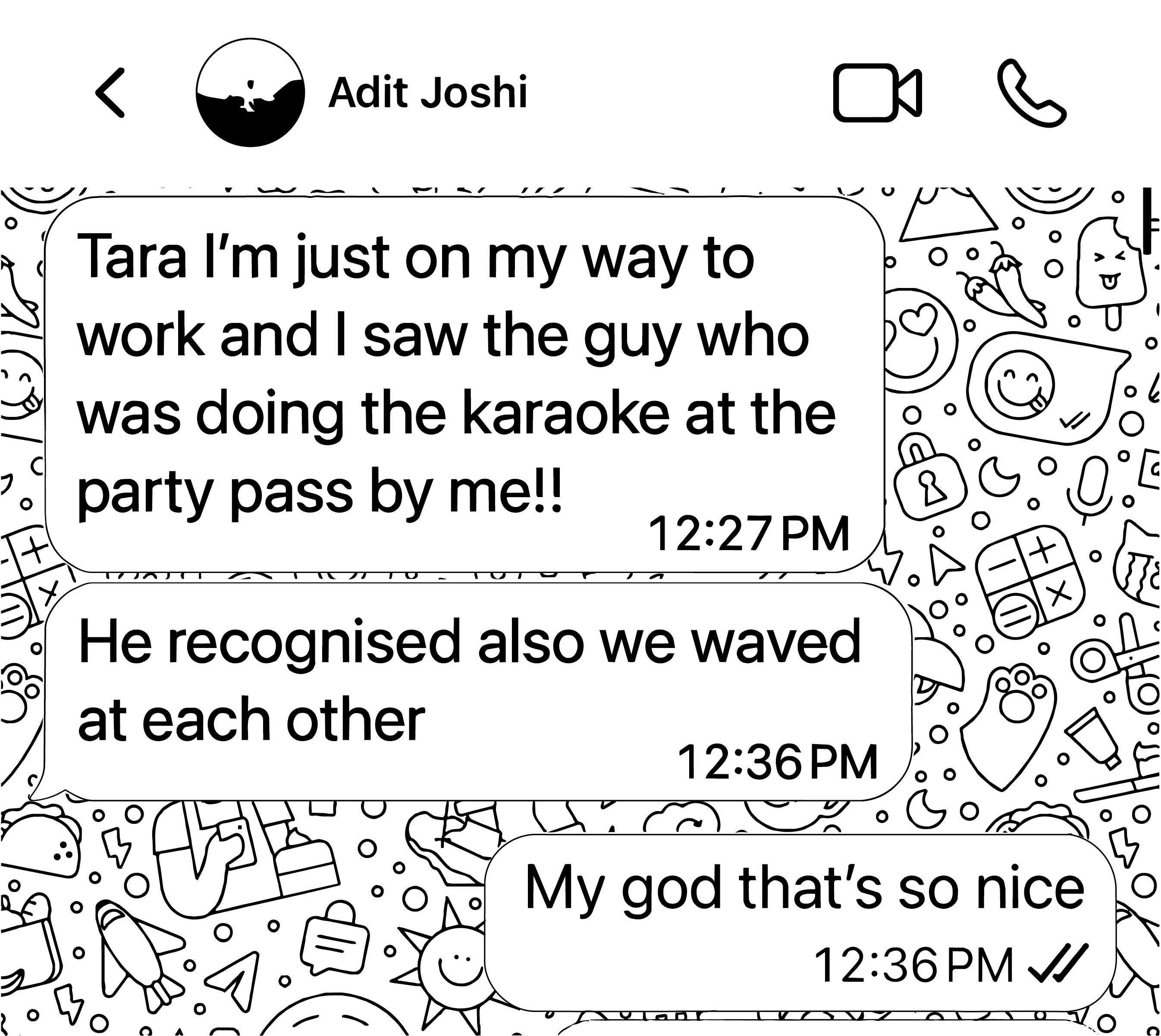
Real t-shirt is eating a butter cookie and asks if he can bring his friend up. He says he left his friend downstairs thinking he’d be right down. I say no problem, but he calls the friend and the friend declines. I offer pop rocks to everyone, a bit apprehensively. Three workers hold their palms out like they’re receiving prasad. I can hear some popping but all three keep a poker face. Everyone’s been sitting for a long time. I ask if they’ll get in trouble with the app. They say the app doesn’t do anything to us, we just won’t make as many earnings. No-one gets up. I say "but don’t you lose your incentives?”. “Yes, if our ID goes offline we lose all our incentives for the day and that time doesn’t count anymore. We have to work extra. But if it becomes midnight and we haven’t finished the target, all those hours are lost. Daily and also weekly can go”. I wonder how many this will happen to today [after this party]. They talk about how everything has become so expensive but their earnings have decreased per kilometer. A worker gets up to leave and says they aren’t allowed to take gifts, the first one to say that, but takes it anyway. I tell him there’s a QR code on the card inside and it will lead to helpful info for workers. He comes back in a few minutes and says he forgot to ask for the OTP.
They say their stores each have 50 workers, and how they are friendly with each other but there isn’t much time to talk, they’re mostly running. We take a big group selfie. They start talking about how they should go, how they have really liked being here. We talk about the sight seeing they do in Bangalore, and how one of them just made his first trip to a neighbouring city Mysore, another says when his few months of work are done he will go to Nandi Hills. Another has been to Bannerghatta and seen tigers. “They have every animal there”. They tell me the work is lonely, but they have no option. Adit tells them about working for delivery apps in the Netherlands, how it was better there, but also lonely. He says he delivered pizza to a party of boys his own age and how weird it felt, they took it and closed the door. Someone says, “This was really good, it felt really good.” “We were confused when we were coming here, all to the same address. I tried to race them.” I can feel the day coming to an end and very out of character give a small passionate speech to the group - everyone’s really young and they’re all paying very close attention. I tell them how they all have agency to change things, and how there’s so many of them, against just one app. I feel a bit teary but fight it back and then it’s over. There’s a big round of bye-byes and thank yous, everyone takes gift bags, it feels like a real party ending. There’s so much food left. I try to give them samosas, they all politely say no and finally one boy accepts and puts them in his bag.
Credits
Work Party is a project by Tara Kelton, developed during Web Residencies No. 22, “Ignore All Previous Instructions”, at Akademie Schloss Solitude, curated by !Mediengruppe Bitnik.
Thank you to Sarah Donderer and Akademie Schloss Solitude; to !Mediengruppe Bitnik; to Grayson Earle; to Adit Joshi, Bunyan Usman, Qusai Kathawala, Avinash Veeraraghavan, Uma Shankar, Sumitra Magar, and to everyone who came in; and to the other residents of Web Residencies No. 22: Hermidas Anggara, automatonomy.net, Olivier Jonvaux, Mahoutondji Kinmagbo and Lucia Rebolino.
© 2026 Akademie Schloss Solitude, Stiftung des öffentlichen Rechts, Stuttgart, and Tara Kelton.